A year and a half ago we installed three 200W Renogy Solar Panels on the roof of our Reconn R2 Hyper Camper.
I’ve been super excited to see how they go, and whilst we only got a rough indication of their performance at home, I’ve since been able to give them a real work out off grid on our lap of Australia, and so far, I’m quite impressed.
If you’re looking at the Renogy portable solar panel options, we’ve also been testing the Renogy 400W portable solar panel, and the Renogy 200W portable solar panel.
What Renogy Solar Panels are we running?
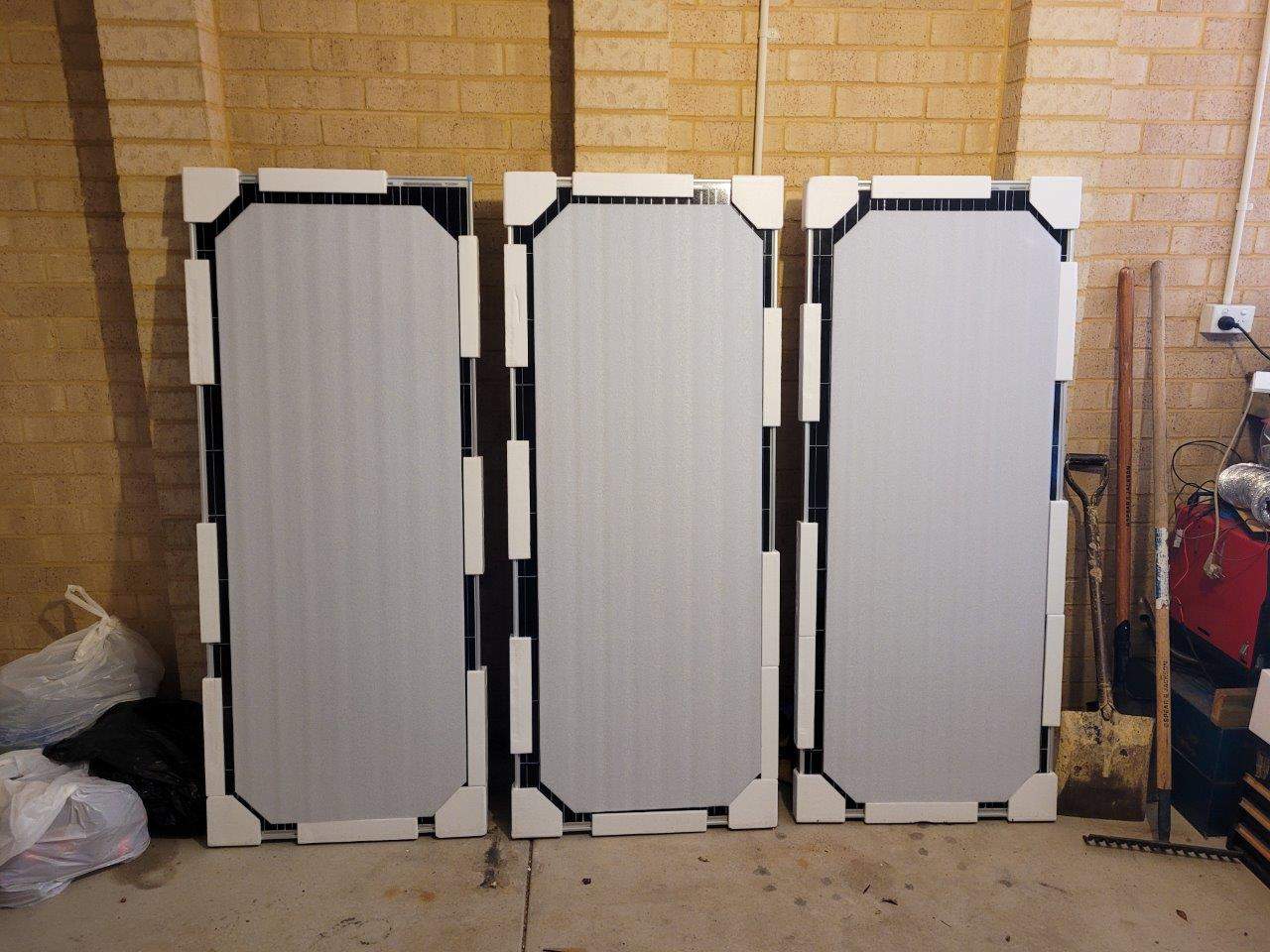
I purchased three 200W 12V Renogy Solar panels, weighing around 12kg each.
These panels are 1650mm x 670mm, and are actually smaller than the 200W Low Energy Development Panels I ran on our soft floor camper (and still have one on our Isuzu Dmax).

Renogy Solar panel price
Today, the 200W Renogy solar panels are $309 each, but if you wait for a sale you can get them for much cheaper. Our total lithium and solar upgrade was $3164 including our 2 of 170 ah Renogy lithium batteries, a solar controller and 3000W inverter.
Looking back at the purchase, we paid $230 per 200W panel, for a total of $660 for 600W. Almost $1 per watt, which isn’t bad, especially when its from a big, well known company like Renogy.
What controller is looking after the panels?
I feel like we’ve got enough Renogy gear to own half of their business (but we paid for the whole lot), but have been fairly happy with it so far.
The 600W of caravan solar panels are going into a Rover 60 Renogy MPPT controller, which is charging our 340aH of Renogy Lithium Batteries.
I suspect that the controller plays a massive role in how much you get out of the solar panels, and fitting a rubbish quality solar controller would hurt your ability to get decent efficiencies.
So far the Rover 60 seems pretty good, although the lithium profile settings were a bone of contention for some time, that I have since resolved.
Its also worth noting that the 120W solar panel on the roof of our camper has been disconnected (although I can plug it into our Enerdrive DCDC when we setup camp each time), and I might do some testing plugging it in with the others.
Update – I suspect this is a bad idea, with the open circuit voltage being vastly different, so now just use it through the Enerdrive unit.

How are the caravan solar panels attached?
I’ve got a comprehensive post that covers the caravan solar panel installation, but these are held onto the roof of our camper with aluminium angle and Sikaflex, and that’s it.
Yes, there’s a very comprehensive way to mount them correctly, but they are rock solid and I don’t expect to have any issues going forward.

How do they perform?
Almost every single 12V panel that I’ve messed with does not deliver its rated wattage (except for the All Spark folding panel I borrowed from a mate for some testing), and that’s pretty sketchy. If you buy a 200W solar panel, that’s what it should deliver, but most don’t seem to do this.
Even worse, if you get a solar panel off eBay (or anywhere for that matter), there’s a good chance you are getting even further ripped off, by sellers falsely advertising the wattage, based on the physical dimensions. I’ve seen 160W solar panels advertised as 300W panels, and that makes me really angry.
I digress though; the Renogy Solar Panels perform really well. They are permanently mounted, and are flat, with no ability to turn them to follow the sun. I’d expect a reduction in performance purely because of this, with both maximum instantaneous generation, and daily generation.
However, the peak generation recorded is 839 watts so far, and I’ve seen it a number of times sitting at 550 – 750W, so they clearly do what they are rated to do, despite not being in the best possible operating conditions (facing directly at the sun).
Initially, during our travels through South Australia they were working so well that I unplugged the Anderson that attaches our camper trailer to the car, so our batteries were purely being charged by solar.
Even on days where it was partly/mainly cloudy, we were seeing our batteries completely full by 12 – 1PM, and that’s replacing around 120 – 150aH of consumption.
The maximum amps I’ve seen going in is somewhere around 48, which is seriously impressive. When its completely overcast and raining (as in no real light getting through) we are still seeing between 50 and 120 watts going into the batteries, which is enough to run our freezer and basic supplies.
If we get really low, we use our induction cooktop on the Dmax DIY lithium battery system, or swap to gas as needed.

On a clear day in South Australia, when the solar panels are reasonably clean (but not perfect) the panels seem to pump in between 30 and 34 amps (with the freezer on, so really 34 to 38) for the bulk of the solar day.
So far, our best generation is 253aH, or around 3.46kwH, when the batteries were fairly low. I suspect it would still do more than this on a perfect day if the batteries were flatter, but they do really well.
EDIT – I’ve seen the performance of these panels, or the system as a whole decline since heading north from South Australia.
In South Australia, they were pumping along, when it was cooler weather. When we headed north though, their performance seems to have dropped off, and now in Queensland we aren’t getting near the 600W that they are rated at, which is not completely unexpected, but certainly makes a big difference.
On a 31 degree day in Mt Surprise (inland of Mareeba, in the northern parts of Queensland), we are seeing around 360 – 400 watts in perfect sunshine. The angle of the sun is a lot lower than it was in South Australia, and with the extra heat I have no doubt that the panels suffer some efficiency loss.
We’re still very happy (and to be honest, were surprised to initially achieve 600W from 600W of panels in South Australia when they aren’t following the sun due to being mounted flat is very impressive).
It does however, mean that we are now using the Anderson plug to charge the camper when we are driving most times, and I often plug our 120W panel on the roof into the Enerdrive DCDC for some extra power too.
If it gets very low, I pull our Kings 200W blanket out, which is pretty average, but it all helps. In total then, we can easily have 920W of panels feeding into the lithium batteries.
The other major surprise in Queensland is the number of overcast, and even raining days, which does not help solar generation at all!
They are 27V
I make a point of mentioning this, as the voltage of these panels is higher than many other 12V ones on the market, and it may not be compatible with your controller.
Even the Renogy DCDC charger in our Dmax is limited to 25V (they’re now 50V), so we couldn’t run these panels to it. Our MPPT unit does it fine, but look at the maximum voltage for solar input on your charger before you buy these.
Support the blog
If you’ve found this review useful, and are going to buy Renogy products (please don’t feel like you have to), we’d very much appreciate you using our link, which costs you nothing but gives us a small commission, and allows us to continue doing independent, in depth testing on all sorts of products. Here’s the link – Renogy Australia.
Renogy Solar Panel review
Overall, I’m quite happy with these panels. They can do what they are supposed to, are compact, relatively cheap and I expect we’ll have a good run with them.
I suspect Renogy is going to become far more common in Australia, as its decent gear without the brand name price tag that is selling so much other 12V gear in Australia.
I need to do some more testing to see how they are performing when they are clean, in perfect sun in Queensland compared to South Australia, but they’ve certainly dropped off a fair bit, which I find a bit weird.
I’d say they are better quality than the Low Energy Development ones because they perform better, but also because they are a smaller unit. The Low Energy Development 200W panels were 1580mm x 808mm (1.277m2), and our Renogy ones are 1650mm x 670mm (1.1m2).
Overall, I’m a happy camper and would get these again. Of course, we’ll keep you updated with how these go long term, and if we have any problems you’ll know about it.
