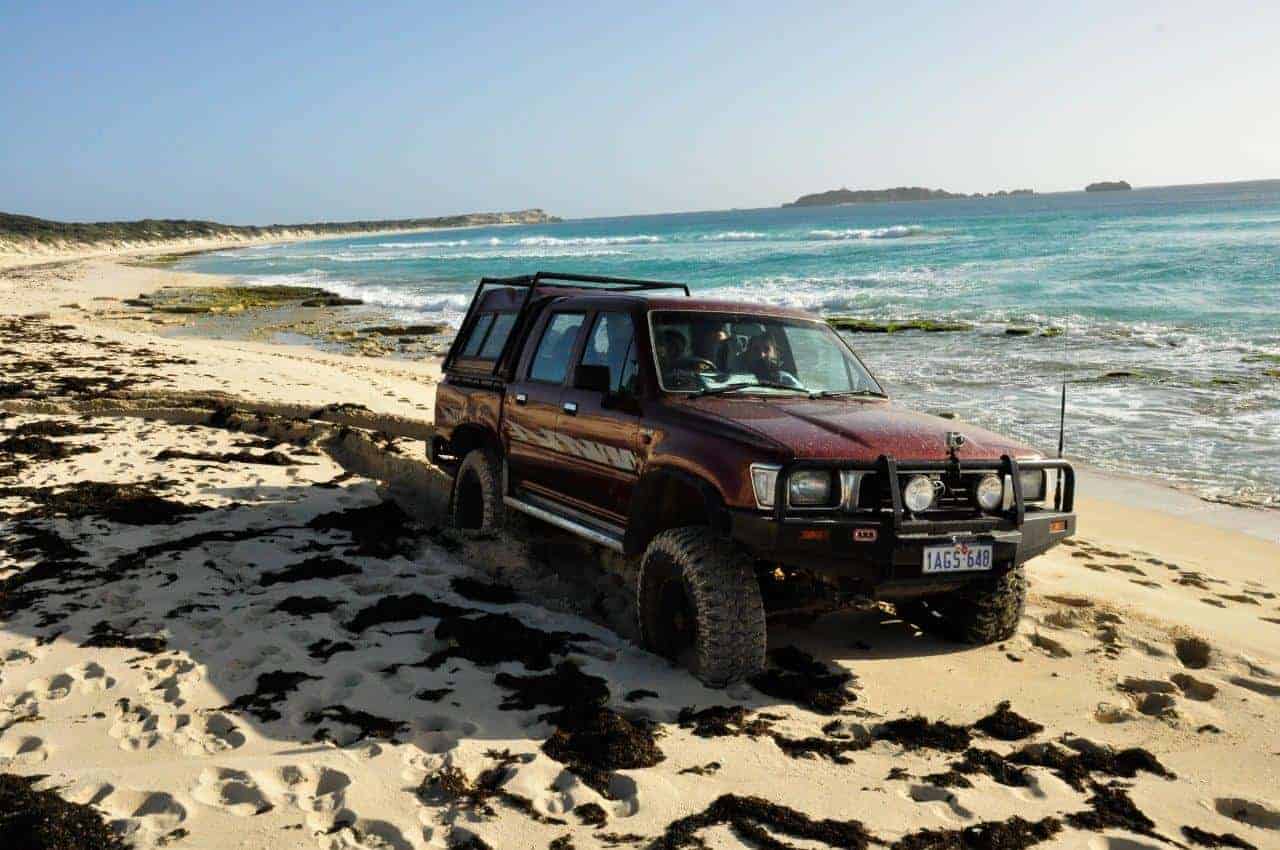
If your 4WD gets bogged on sand, there’s a good chance you are running your tyres with too much air in them. Every vehicle and beach is different, but often people are far too conservative when it comes to deflating their tyres enough for beach driving.
There’s nothing more frustrating than getting stuck behind a bogged 4WD on the beach, whilst they struggle to move half a meter because of the wrong tyre pressures.
There is a correct tyre pressure for beach driving, and it depends on your vehicle, tyre size and how soft the sand is!

Why do you let your tyres down for beach driving?
When you let air out of your tyres, the surface area of rubber contacting the ground increases. It gets slightly wider, and a lot longer. From full tyre pressure down to around 15PSI your surface area nearly doubles.
This means that instead of the weight of your 4WD being distributed over each tyres small footprint (and forcing the tyres to sink), the load is spread over pretty much double the area, and allows the tyres to float over the top of the sand.
The best tyre pressure for sand is the one that allows you to drive over it easily and safely.

What happens if you don’t let your tyres down enough?
Asides from dramatically increasing the chances of your vehicle getting bogged on the beach, you work your engine considerably harder.
A 4WD that has to bulldoze its way through soft sand as a pose to allowing the tyres to float over the sand will often run much hotter, and can easily cause engine damage if you aren’t careful.
This also results in using a lot more fuel than if you adjusted your pressures properly.

You will find that you dig huge ruts with tyre pressures that are too hard as well, which will make it very difficult for anyone else to follow in your tracks.
Asides from the giant ruts, tyres that are not deflated enough spin and create bumps on the track. You might not think it makes much of a difference, but its a terrible feeling trying to follow a track whilst you are getting thrown up and down!
After a big Easter at Yeagarup the tracks were so badly chopped up that it was almost impossible to get enough momentum to drive up the exit dune.
The bottom line though, if you don’t have the PSI for beach driving you risk getting stuck. If this happens to be as the tide is coming up, you are putting your pride and joy at risk.

How do you know when you have the right tyre pressures?
It takes a bit of practise to get the tyre pressure correct. For some beaches, you barely have to let the air out at all.
For many beaches in WA though, you won’t make it more than 10 metres from the entrance without proper tyre deflation.

When your 4WD tyres are deflated correctly for beach driving, you should be able to roll without any acceleration for at least a couple of meters.
If you take your foot off the accelerator and the vehicle almost immediately bogs down and stops, you know the tyres are digging in and not floating, like they should be.
Your vehicle shouldn’t be struggling to drive on the beach either; even the softest beaches can be driven by most 4WD’s without any issues. If your car is struggling, go down a bit more and you will be amazed.
If there are signs asking you to reduce your tyre pressure to a certain amount, please follow them. They are there for a reason, and you will chop tracks up without the right pressures.

What’s the best tyre pressures for beach driving?
I tell most people the recommended tyre pressure for beach driving is 16 PSI, and lower as required. Even heavy Land Cruiser and Patrols (like my 80 Series is when it’s loaded up) can be safely driven along the beach at 16 PSI.
For light weight vehicles, like Jimny’s and Sierra’s, you can start off at around 12 PSI. I would not go above 35 – 40km / hour at these pressures!
Be aware that if you corner quickly, your chances of rolling a tyre off the bead increase phenomenally. You should never brake hard, or turn quickly on soft sand anyway, but even more so when you have low tyre pressures.
The heavier your vehicle is, the more air you should keep in your 4WD. Likewise, if you fit taller tyres, you gain flotation and may not need to deflate them as much. The right PSI for beach driving takes a bit of trial and error, and vastly depends on how soft the beach is.
Another thing to remember is the temperature of the air in your tyres. This varies considerably, and your tyre pressures will change a lot depending on whether you read the gauge after driving for a while, or when the tyres are cold.
You can read more about this at Do you check your tyre pressures hot or cold?

Don’t be afraid to let more air out
If your vehicle is struggling at 20PSI on the beach, let some more out. If you go down to 15PSI, that’s 25% less air in the tyres. 5 PSI might seem like very little, but it makes a world of difference.
If you really get in trouble, don’t be afraid to let your tyres down to 8, or even 6 PSI. Obviously, you need to be very careful at these pressures, but they will get you out of trouble if you are buried to the chassis rails with an incoming tide!
I have run my 80 Series Landcruiser at 8 – 10 PSI several times, when the sand was very soft. I don’t like doing it, but with the soft sands we get over here in WA sometimes you have no choice!

Have you been stuck on the beach?
I’d love to hear your stories; leave a comment below. What tyre pressure do you automatically drop to for beach driving?