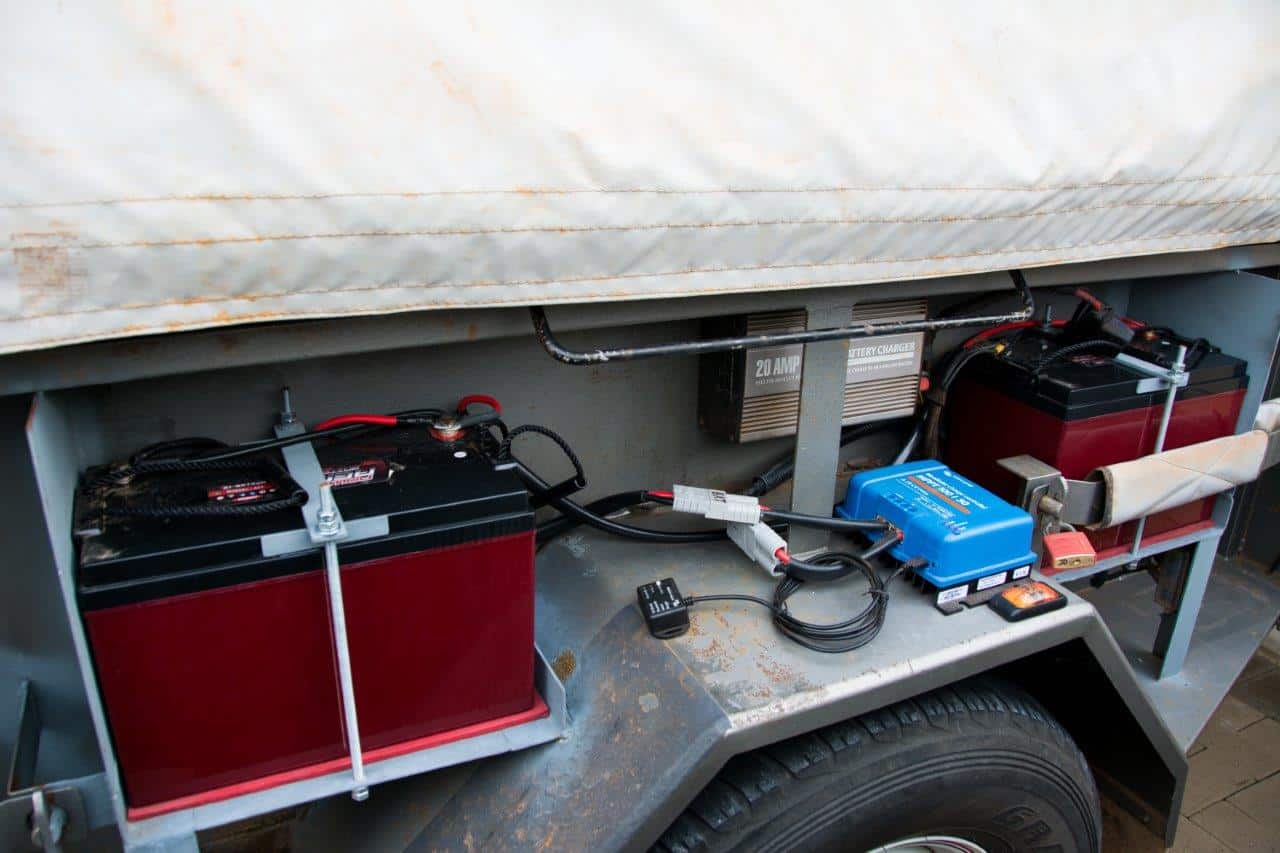
These days, 12V batteries are the heart of many camping setups. Whether you are using a dual battery system in the back of a 4WD, or you have batteries in your camper trailer, caravan or RV, they are used everywhere for running a heap of different appliances.
A good 12V system makes camping much more comfortable, but they aren’t cheap to setup and install.
I’m always on a mission to help people travel easier, cheaper and better, and one of my pet frustrations is seeing people damaging their lead acid 12V batteries through a lack of understanding.

Batteries cost a lot of money, and if more people understood what they were doing was expensive and a waste, they’d think twice!
There’s lots of ways you can save money when camping and 4WDing, and this is just one of them. For some more, check out 12 ways to wear your 4WD out faster.
I’m a long way off knowing everything there is to know about 12V systems, but I do know people often run their 12V batteries too flat, and damage them in the process. If you are wondering how low you can discharge a deep cycle battery, read on.

When is a 12V battery flat?
When would you call a battery flat? When your fridge stops running? When your lights turn off? By the time your fridge or lights turn off your battery is pretty much dead. The problem with this is there’s a direct link between how much you flatten your battery, and how many years (or cycles) it lasts for.
Sure, some fridges have adjustable voltage cut offs, but at the end of the day if you aren’t aware of the state of charge of your battery you are running a risk of shortening the battery life. Your AGM battery minimum voltage is critical for long life.
Now, I will be quick to point out that AGM batteries also have a lifespan, regardless of how much you use them. After 5 years, if your AGM is still working well, you’ve done well.
This means its a battle between battery age, and cycles. There’s no point limiting the amount you consume each cycle to make the battery last longer, if its going to fail long before you maximise the cycle use.
The deep cycle batteries in our Reconn R2 were nearly at end of life, so we’ve done a big lithium battery upgrade.

Battery state of charge
Your 12V batteries have a state of charge; when they are completely full they are at 100%, and when they are dead as a doornail, they are at 0%. This is where many people go wrong.
For most deep cycle batteries, if you want them to last a long time, you should consider keeping them above 50% state of charge. Say what?!
Yep – most deep cycle batteries have a lifespan of about 1500 – 2000 cycles when you discharge them only 30% (so 70% state of charge). If you cycle it down to 50% state of charge, you get roughly half as many cycles before the battery needs replacing.
Go lower than that and your deep cycle battery lifespan drops even further. Have a look at the deep cycle battery voltage chart in the photo.
Ideally then, you don’t run your battery below 70% state of charge, but this is impractical. If you had a 200 amp hour battery system, you could only use 60 amp hours, which is ridiculous. It becomes a balance between having enough battery capacity and not wrecking what you have.
It’s not practical to carry a tonne of batteries, but at the same time not economical to quarter the life of your batteries. You’ve got to find the balance for yourself.
Please remember that this refers to the floating voltage after nothing has been drawn or added for at least half an hour. If you draw a lot of power the voltage will drop down significantly and then re-bound in time.
Also, you need to make sure that you are charging your batteries properly, to get the maximum life out of them.
AGM battery voltages can be different to a traditional lead acid, or calcium battery and they are most certainly very different to Lithium battery voltages (and these also have a very different amount of usable power).
Check your battery specifications
How low can you discharge a deep cycle battery? It all depends on the specs! A good idea is to look at the specifications of your battery, and work out how many cycles it will do at the given state of charge that you want, and then work out how long the battery will last for.
For example, if you had a 200 amp hour battery, and you decided to discharge it to 30% every day (using 140aH), it might have a lifespan of 500 cycles.
If you are using it full time, that’s effectively 1.5 years before the batteries are dead as a door nail. If however, you are using it for camping for 50 nights a year, that’s 10 years before the batteries are dead, and they are going to fail before that time anyway.

What does this mean in terms of usable power?
If you have a 100 amp hour battery, it means you should only be using 30 – 70 amp hours before charging the battery again. Most fridge/freezers use in between 20 and 120 amp hours a day.
Next time someone tells you their battery runs a fridge and lights for 3 days without charging it, let them know they are probably damaging their batteries (unless they have a massive power bank). It’s simply not possible any other way.
Our 80 Series has a 105 amp hour battery, and 66 amp hour cranking battery (with probably 15 usable amp hours before the isolator kicks in). Using the 50% rule, that gives us a maximum capacity of 52 + 15 amp hours.
Our Evakool draws around 25 – 30 amp hours over 24 hours, giving us just under two days of ‘off the grid’ camping. We run a number of solar panels, and are often driving anyway, but having a voltage gauge has been a great addition.

State of charge and safe discharge rates vary
Not every battery is the same; every one will have a different number of cycle rates for various state of charges.
Take a minute to find out what your safe discharge rates are, and how many cycles you will get out of it. AGM vs lead acid and calcium deep cycles are not the same.
When does a 12V fridge cut out?
12V Fridges will cut out anywhere from 12.5 volts to 10.1 volts, depending on the fridge model. Some of them are adjustable, but in general if you are allowing your fridge to cut out you could be reducing the batteries lifespan.
Running different batteries in the same system
Another very easy way to damage your batteries is to run different batteries in the same system. Lead acid deep cycle batteries, AGM, Gel and Calcium all require different charging rates, and if you are charging several different batteries at the same voltage, you will do damage to them very quickly.
It’s not a good idea to mix and match different battery types, but many people do.

This is just a basic introduction
The bottom line is this; run your 12V system however you want to, as long as you understand the consequences.
If you still choose to run your batteries down to 20% state of charge that’s fine; its your call and I’m not going to get in the way of it.
The purpose of this post is to help those who don’t understand what they are doing can damage and shorten the lifespan of their batteries, and give them the knowledge to change things.

I’ve made this quite basic too; realistically its more complicated when you look at Watts, cable sizes, current draw as the battery voltage drops etc.
However, for the purpose of a basic guide, I will leave it at that; its easy to get confused with too much information too quickly.
Who’s guilty?
Righto, who’s run their battery system down too far? I’ll put my hand up first; on our 5 weeks in the Kimberley our second battery started playing up, and unknown to me it was a normal lead acid battery with a very low amp hour rating.
Every morning our fridge was dead, until we got back into Broome and replaced it with a new deep cycle.
So, have you run your battery flatter than you should have?!